Hundreds of employees are using AI every day. Each has built a personal collection of prompts in their individual ChatGPT, Claude, or Gemini accounts. The organization cannot see those prompts, cannot audit them, cannot recover them if someone leaves, and has no way to know what business data is embedded in the context being sent to third-party LLMs.
Enterprise AI prompt governance is the set of policies and systems that control how AI prompts are created, reviewed, shared, versioned, and retired across an organization. It addresses data leakage risks, ensures consistent AI outputs, creates audit trails for compliance, and defines who can create and edit the prompts that power an entire organization's AI workflows.
Why Enterprise Prompt Governance Is Different from Individual Prompt Management
Individual prompt management is a personal productivity problem: save your best prompts, organize them, reuse them. Enterprise prompt governance is a different category of problem entirely.
At the individual level, the stakes of a bad prompt are low. You get a suboptimal output, you iterate, you move on. At the enterprise level, a bad prompt approved for org-wide use affects hundreds of users simultaneously. A prompt containing the wrong legal language goes into every contract draft. A prompt that subtly misrepresents the brand voice appears in every customer-facing communication. The failure mode scales with adoption.
Prompts also cross team and department boundaries in ways that create governance complexity. The sales team's proposal prompt may reference financial figures that marketing should not be sending to external LLMs. The HR team's performance review prompt may contain PII - personally identifiable information - about employees. Legal team prompts may contain attorney-client privileged context that should never reach a public model. These are not hypothetical edge cases. They are the natural result of employees doing their jobs efficiently with AI tools.
The question a CISO is now asking is not "are our employees using AI?" They are. The question is: "What business data is leaving our network embedded in prompt context, and who approved the prompt that sent it?" Without a prompt governance layer, there is no answer to either half of that question.
Prompt sprawl compounds the risk. When teams have no shared library, employees recreate the same AI prompts independently - often including context that a carefully reviewed template would have kept out. The absence of governance does not mean fewer risks; it means the same risks repeated across every variation of every prompt that every employee writes from scratch.
The Four Governance Risks Every Enterprise Faces
Data Leakage Through Prompt Context
The most immediate risk is also the least visible. Employees paste sensitive data into prompts sent to third-party LLMs as a matter of routine: customer names and contact details, financial projections, M&A context, strategic plans in draft form. None of this is malicious. It is the path of least resistance when the task is "help me draft a response to this client" and the most natural approach is to paste the client's account history directly into the prompt.
GDPR, CCPA, and SOC 2 compliance frameworks all have implications for personal data processed by third-party systems. When an employee pastes customer PII into a prompt sent to a public LLM, the organization may have transferred personal data to a third party without the data subject's knowledge or a compliant data processing agreement in place.
A shared prompt library with standardized variable templates directly reduces this risk. The template specifies exactly what goes in {{variable}} fields - {{customer_industry}} rather than a pasted customer record, {{deal_stage}} rather than actual financial terms. The structure of the template constrains what data gets included, which is the only reliable mechanism that does not depend on individual judgment under deadline pressure.
Prompt Inconsistency at Scale
Five hundred employees each using their own version of the same prompt is five hundred different outputs. For tasks that affect brand voice, legal language in contracts, or communications in regulated contexts, this inconsistency is not acceptable.
The legal team's approved contract clause language, refined through months of review, needs to appear in every AI-assisted contract draft - not just in the contracts drafted by the person who originally wrote the prompt. The compliance disclaimer that must appear in client communications cannot be present in some AI-assisted emails and absent from others based on which personal prompt template each employee happens to use.
The solution is an org-approved prompt that becomes the default, not one of five hundred options. This requires a shared library with a mechanism to surface approved prompts at the point of use, inside the AI tools employees are already working in.
Knowledge Loss on Attrition
The individual-level version of this problem is well documented: a high performer leaves and their best prompts leave with their personal accounts. At the enterprise level, the scale of the loss is proportionally larger.
The department head who spent months refining the team's most effective prompts - the customer analysis framework, the executive summary template, the competitive positioning prompt - is not just one person's productivity asset. Those prompts represent the team's accumulated AI expertise. When they live in a personal account, they vanish with their creator. The team reverts to less effective prompts or rebuilds from scratch.
For a detailed breakdown of what this costs and how to recover prompt knowledge during offboarding, see our guide on what happens to AI prompts when an employee leaves.
No Audit Trail for AI-Generated Outputs
Regulated industries need to answer a specific question when AI-generated content is involved: what prompt generated this output, who approved that prompt, and when was it last changed?
Without a version-controlled shared library, that question has no answer. A financial summary sent to a client was generated by some version of some prompt that some employee was using that day. Whether it was the approved version or a personal variation that included an unchecked variable is unknowable after the fact.
When a PII exposure incident occurs - a customer's personal information appeared in an AI-generated document that was sent to the wrong recipient - the inability to reconstruct what prompt instruction produced that output is a compliance problem on top of the incident itself. There is no paper trail. There is no version to audit. The incident investigation starts from zero.
The Three Layers of Enterprise Prompt Governance
Layer 1 - Access Control: Who Can Do What
Enterprise prompt governance starts with a role-based access control (RBAC) model applied to the prompt library. RBAC in this context means every user and every folder has a defined permission level: read-only access, editor access, or admin access.
A marketing team member should be able to use the legal team's approved contract language prompts but not edit them. A department head should be able to promote prompts from draft status to team-wide visibility. A compliance officer should have read access across all organization folders for audit purposes without having edit rights that could alter the prompts they are auditing.
Department-scoped libraries extend this: the legal team's approved prompts are not accessible to marketing by default, not because the content is secret, but because approved prompts carry implicit endorsement, and cross-department endorsement requires a deliberate decision.
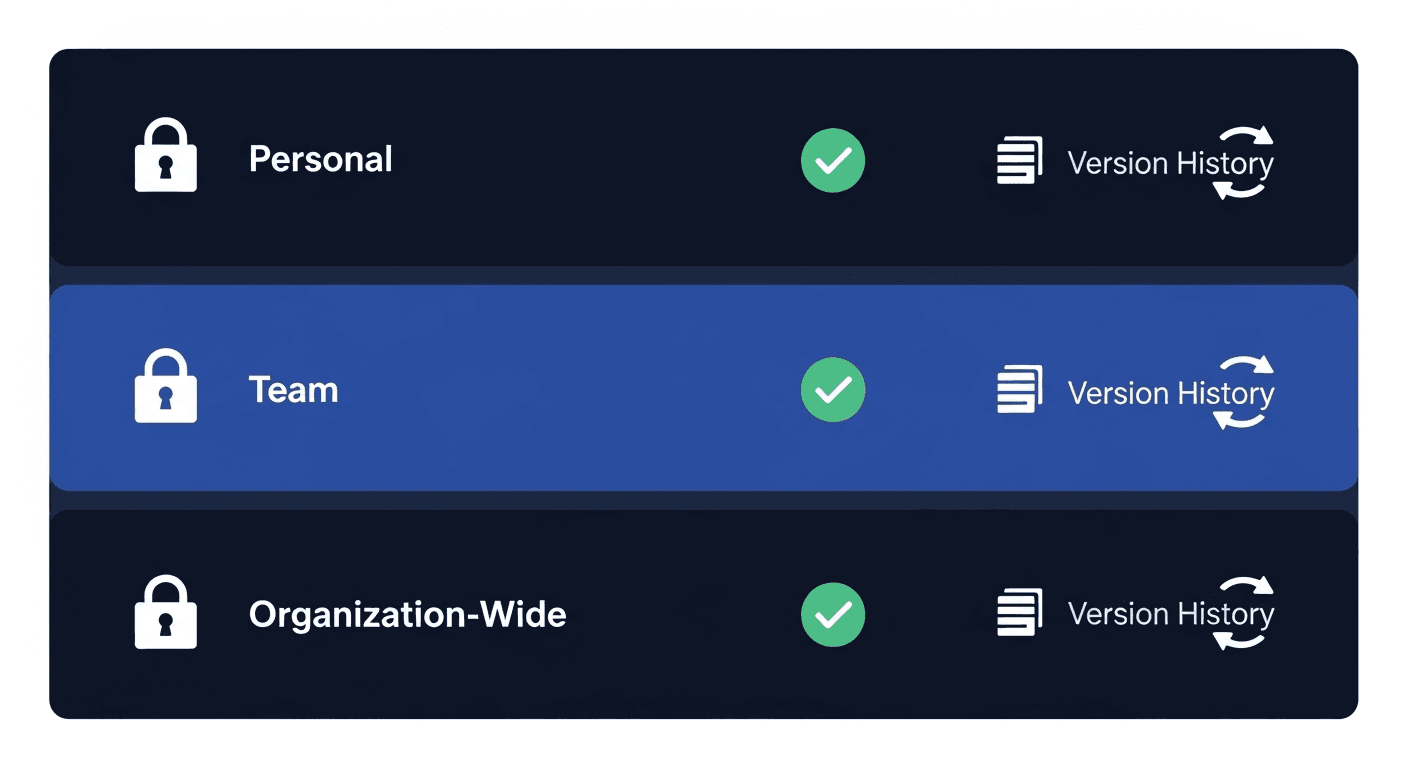
The three-tier permission model that works in practice: personal prompts visible only to the creator; team-scoped prompts accessible to a department or project group; and org-wide approved prompts reviewed and published to the full organization. Each tier requires a different authorization to promote a prompt upward, which creates the approval workflow at the natural transition points.
Layer 2 - Versioning and Audit Trail: What Changed
Every edit to a shared prompt should create a new version with a timestamp, the identity of the editor, and a record of what changed. This is not primarily a rollback mechanism, though rollback capability is valuable. It is the audit trail.
When a compliance team needs to demonstrate that the prompt used to generate a particular category of output was reviewed and approved at a specific date, the version history provides that documentation. When a prompt change produces worse or non-compliant outputs and needs to be reverted, the version history makes that operation clean rather than a matter of trying to remember what the previous version said.
Version history is also the answer to the regulated-industry audit question. The question "what prompt generated this output and when was it last approved?" becomes answerable when every shared prompt has a version timeline accessible to the compliance officer reviewing it.
Layer 3 - Governance Policy: The Rules
Access controls and version history are technical infrastructure. The governance policy is what gives that infrastructure meaning.
A prompt governance policy should specify which data categories cannot appear in prompts sent to public LLMs - PII, financial data, patient data, attorney-client privileged content, and any M&A-related information are the usual starting categories. It should define the approval process for promoting prompts to team-wide or org-wide status: who reviews them, what the review checks for, and how long the review process takes. It should establish a review cadence for active shared prompts, because AI models update and prompts that worked well six months ago may need refinement. And it should assign ownership - a named person or role for each department's prompt library, responsible for maintenance and retirement decisions.
Industry-Specific Prompt Governance Considerations
Financial Services
SOC 2 and financial services regulatory frameworks place record-keeping requirements on communications and outputs generated in client contexts. AI-generated outputs used in client communications - portfolio summaries, market commentary, trade rationale documentation - fall within scope of those requirements in most jurisdictions.
The specific risk: a shared prompt for generating client portfolio summaries that includes {{account_balance}} in the template is not inherently problematic. That template specifies a placeholder. The governance risk emerges when the template is used in ways the template author did not intend - when an employee interprets {{account_balance}} as an invitation to paste actual account data into the prompt before sending it to a public LLM.
The governance layer that addresses this is prompt-level documentation: the template specifies not just the variable name but the data classification of what should fill it, with a clear statement that actual financial data must not be sent to a public LLM API. Model selection is the other lever - some regulated data categories require an on-premise or private model rather than a public LLM, regardless of prompt structure.
Healthcare
HIPAA implications for patient data in prompt context are the central concern in healthcare AI governance. Patient identifiers - names, dates of birth, medical record numbers, condition specifics - have no place in prompts sent to public LLMs.
The practical prompt governance rule: templates should never contain patient identifiers in variable placeholders. The template {{patient_name}} is not safer than pasting a patient name; it just formalizes the unsafe practice. The correct template uses de-identified categories: {{condition_category}}, {{age_range}}, {{treatment_type}}. The governance policy then specifies that prompts containing any patient-identifiable variable placeholder require on-premise model usage.
Clinical documentation governance adds a second dimension: who approved the prompt that generates a clinical summary, what clinical scenarios was it tested against, and does it meet the documentation requirements for the relevant care setting? These are not just data compliance questions - they are patient safety questions, and they require an approval workflow with clinical review, not just IT review.
Legal and Professional Services
Attorney-client privilege is the governing concern for legal team prompt governance. Prompts containing case-specific information, client strategy, or confidential legal analysis sent to third-party LLMs may expose privileged content to the LLM provider, potentially compromising the privilege.
The governance policy for legal teams should be explicit: prompts containing case-specific or client-confidential information must use an on-premise or private model rather than a public API. This is not an optional guideline - it is the boundary that protects both the firm and its clients.
Contract drafting prompts sit in a different risk category. A prompt template for drafting a specific clause type carries legal weight when it is used at scale across an organization. An error in the approved template is replicated in every contract generated from it. This makes the approval workflow non-optional: contract drafting prompts require review by a licensed attorney before reaching org-wide status, and changes to approved contract prompts require the same review cycle.
How to Implement Prompt Governance Without Killing Adoption
The governance programs that fail are the ones that launch with "you must use the approved library and only the approved library." The ones that succeed launch with "the approved library is the fastest way to access good prompts." Adoption follows utility, not policy.
Step 1: Audit current prompt usage. Survey teams to understand what prompts exist, where they live, and what types of data they contain. Most organizations discover more informal prompt collections than expected - shared drives, Slack threads, personal notes, and browser bookmarks, alongside the expected personal AI accounts. The audit also surfaces which teams are doing the most sophisticated AI work, which is where governance infrastructure will deliver the most immediate value.
Step 2: Define data classification rules. Specify which information categories are prohibited in prompts sent to public LLMs: PII, financial data, attorney-client privileged content, patient data, M&A-related information. This list does not need to be exhaustive on day one. Start with the highest-risk categories identified in the audit and expand from there. A data classification policy that covers three categories and is actually followed is better than one that covers twelve categories and is ignored.
Step 3: Build the access control structure. Three tiers: personal prompts visible only to the creator, team-scoped prompts accessible to the department, and org-wide approved prompts reviewed and published to all. Each tier has different permission requirements for promotion. The RBAC model at the folder level handles department-scoped access without requiring custom configuration per user.
Step 4: Implement an approval workflow for shared prompts. Prompts that reach team-scoped or org-wide status require review before publishing. Define who reviews based on category: a legal team prompt goes to the general counsel for review, a customer communication prompt goes to brand and compliance, a financial analysis prompt may need both compliance and a senior analyst sign-off. The review checks data classification compliance, output quality, and any category-specific requirements like legal language accuracy.
Step 5: Launch with one department, not the whole organization. Governance rollouts fail when they try to change everything at once. Select the highest-risk department - legal, finance, or HR - and establish the full governance model there first. The first department will surface the gaps in the policy and the workflow before they become organization-wide problems. Once one department has a functioning governance model, other departments adopt it faster because the template, the approval process, and the access structure are already proven.
For a full overview of the underlying prompt management infrastructure that makes governance possible, see our complete guide to prompt management and our guide on the best prompt management tools for teams using multiple AI tools.
What an Enterprise Prompt Governance Policy Should Cover
A checklist for compliance officers and CISOs building or reviewing a prompt governance policy:
- Scope: which AI tools and use cases the policy covers - public LLMs via browser interface (ChatGPT, Claude.ai, Gemini), API integrations, Microsoft Copilot, Claude for Enterprise, ChatGPT Enterprise, and any internal LLM deployments
- Data classification: prohibited data types in prompts sent to external LLM providers, with concrete examples for each category - not abstract categories, but examples employees can recognize
- Approval tiers: who can create, edit, and approve prompts at each permission level, with named roles or positions rather than vague references to "management"
- Audit cadence: how often active shared prompts are reviewed, by whom, and what triggers an out-of-cycle review (model updates, compliance changes, incident reports)
- Incident protocol: the specific steps to take if sensitive data was included in a prompt sent to a third-party model - who is notified, what the investigation requires, whether the incident triggers reporting obligations
- Training requirement: what employees must understand before accessing org-wide approved prompts, and how that understanding is verified
One distinction worth making explicit: ChatGPT Enterprise and Microsoft Copilot provide data privacy protections at the model level - prompts and outputs are not used for model training, and data stays within the organization's contracted environment. These are real and meaningful protections. But they do not provide a cross-platform shared prompt library with versioning and approval workflows. Enterprise prompt governance tools solve a different problem than enterprise LLM subscriptions. Organizations in regulated industries typically need both: enterprise LLM contracts for model-level data protection, and a prompt management layer for the governance infrastructure around what gets sent to those models.
For HR-specific compliance considerations around AI prompt governance - including employee data handling and performance review workflows - see our guide on prompt management for HR teams.
Frequently Asked Questions
What is enterprise AI prompt governance?
Enterprise AI prompt governance is the combination of policies, access controls, approval workflows, and audit systems that manage how AI prompts are created, shared, and used across an organization. It addresses data leakage risks (sensitive data embedded in prompts sent to third-party LLMs), prompt consistency across teams, knowledge retention when employees leave, and the audit trail requirements of regulated industries. The governance layer sits above the AI tool itself and applies regardless of which LLM the organization uses.
How do enterprises prevent data leakage in AI prompts?
Two mechanisms work together. First, a data classification policy defines which information categories - PII, financial data, patient data, attorney-client privileged content - cannot appear in prompts sent to public LLMs. Second, standardized prompt templates with variable placeholders replace ad-hoc context inclusion. A template specifying {{de-identified_issue_type}} is structurally safer than an employee pasting raw customer data into a freeform prompt, because the template constrains what data can be included rather than relying on individual judgment in the moment.
Do regulated companies need to log which AI prompts were used?
In financial services, healthcare, and legal contexts, the audit trail requirement effectively requires this - not necessarily logging every individual use, but maintaining the ability to demonstrate what prompt generated a given output, who approved it, and when it was last modified. A prompt management system with version history creates that audit trail for the prompt side of AI-generated outputs. Whether the specific regulation mandates it depends on the jurisdiction and the output category; the defensible posture is to maintain the capability and use it when needed.
What is the difference between ChatGPT Enterprise and an enterprise prompt management tool?
ChatGPT Enterprise provides data privacy protections at the model level: prompts and outputs are not used for model training, and data stays within a private organizational boundary. An enterprise prompt management tool solves a different problem - organizing, versioning, and governing the prompts themselves across teams and across multiple AI tools including ChatGPT Enterprise, Microsoft Copilot, Claude for Enterprise, and others. The two address different layers of the same compliance challenge and are typically used together in organizations with mature AI governance programs.
How do you get enterprise employees to use a shared prompt library instead of personal accounts?
Governance policy alone does not drive adoption - convenience does. The shared library must be faster to use than the alternative. A browser extension that surfaces the prompt library inside ChatGPT and Claude removes the switching friction that kills adoption. A curated collection of high-quality, tested prompts gives new users a better starting point than a blank input field. Early contributions from respected team leads create credibility with the rest of the department. The sequence that works: build the utility first, establish the behavior, then apply the governance layer to the behavior that already exists.
The Compliance Infrastructure That Makes Enterprise AI Work
Enterprise AI adoption without prompt governance is not a question of if a compliance problem will occur - it is a question of when, and whether the organization will have the infrastructure to respond to it.
PromptAnthology gives enterprise teams role-based permissions so each department accesses only what they should, prompt version history with full audit trails for compliance requirements, and approval workflows before prompts reach team-wide or org-wide status. The browser extension provides access across ChatGPT, Claude, and Gemini so adoption is not a separate problem from governance - employees use the governed library because it is the fastest path to a good prompt, not because policy requires it.
For organizations in regulated industries, the version history and approval workflow are not optional features. They are the compliance infrastructure that makes it possible to answer the questions a CISO, compliance officer, or regulator will eventually ask. Start a free trial or contact us to discuss enterprise deployment options.